Choosing between Class 3 vs Class 4 shingles can significantly affect your home’s protection, long-term costs, and insurance savings. While both types offer impact resistance, the real difference lies in how they’re tested, how much force they withstand, and the long-term performance homeowners can expect.
This guide breaks down everything you need to know, from the UL 2218 testing method to cost differences, pros and cons, and insurance discounts.
What Are Impact Resistant Shingles?
Before comparing shingle classes, it helps to understand what “impact resistant” actually means. Impact resistant shingles are tested through the UL 2218 Impact Rating, which determines how well roofing products withstand hail, debris, and repeated impacts.
These ratings (Class 1 through Class 4) help homeowners choose shingles based on durability and climate needs.
Understanding UL 2218 Shingle Ratings
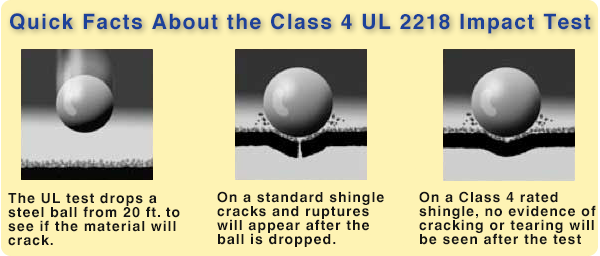
The UL 2218 test drops steel balls of different sizes from set heights to mimic hail impact. Each rating demonstrates a certain level of durability.
Impact Rating Breakdown:
- Class 1: Withstands a 1.25-inch steel ball
- Class 2: Withstands a 1.50-inch steel ball
- Class 3: Withstands a 1.75-inch steel ball
- Class 4: Withstands a 2.0-inch steel ball (highest rating)
Class 4 shingles survive the test without cracking, tearing, or exposing underlying layers, which is why they are considered the highest-performing asphalt shingles.
Class 3 vs Class 4 Shingles: Key Differences
To guide your decision, this section introduces the practical differences between Class 3 and Class 4 shingles. Beyond the basic impact ratings, each class performs differently in real-world conditions, especially in regions with severe weather.
1. Impact Resistance
Impact resistance is the most significant distinction between the two shingle classes. Class 3 shingles are tested to withstand mid-sized hail, while Class 4 shingles are engineered to handle larger, more destructive impacts.
- Class 3 shingles: Withstand mid-sized hail (around 1.75 inches) and may crack or lose granules with repeated impacts.
- Class 4 shingles: Withstand large hail (2 inches or more), repeated strikes, and impacts that often destroy lower-rated shingles.
Class 4 shingles provide a stronger defense against hailstorms, debris, and severe roof stress.
2. Durability
Class 3 and Class 4 shingles both offer enhanced durability compared to standard shingles, but Class 4 products are built with reinforced layers, stronger mats, and improved adhesives.
- Class 3: Suitable for mild to moderate climates, where hail and wind risk is minimal.
- Class 4: Designed for demanding weather conditions, especially in states like CO, TX, OK, KS, WY, and NE that experience frequent hail events.
Homeowners in storm-heavy areas often find that Class 4 shingles significantly reduce annual repair needs.
3. Insurance Discounts
Many insurance companies recognize the added value and reduced risk associated with Class 4 shingles. As a result, they often provide meaningful premium discounts for homes with Class 4 installations.
Class 3 shingles may offer some impact resistance, but they typically do not qualify for the same level of insurance benefits as Class 4.
In many regions, the cost difference between the two classes can be offset by long-term insurance savings.
Class 3 vs Class 4 Shingles Cost
Cost varies based on brand, warranty, and installation requirements, but the main difference is tied to durability.
Average Price Difference:
- Class 3 shingles: Slightly cheaper upfront
- Class 4 shingles: Higher initial cost due to reinforced design
However, Class 4 shingles often reduce long-term expenses through fewer repairs and potential insurance reductions.
Class 3 vs Class 4 Shingles Pros and Cons
Here is an expanded breakdown of the advantages and disadvantages of each shingle class to help homeowners make a more informed decision.
Class 3 Shingles
Here is a quick overview to help set the stage for how Class 3 shingles typically perform in real-world conditions.
Pros:
- Lower upfront cost, making them appealing for budget-conscious projects
- Good performance in mild to moderate climates where hail is less frequent
- Widely available across most shingle manufacturers
- May be sufficient for short-term ownership or investment properties
Cons:
- Limited or nonexistent insurance incentives compared to Class 4 shingles
- Not designed to withstand larger hail or repeated impacts
- More prone to granule loss, cracking, and accelerated wear over time
- Higher likelihood of repairs following storms, increasing long-term costs
Class 4 Shingles
Here is a brief introduction to how Class 4 shingles perform and why they are considered the highest standard in impact-resistant roofing.
Pros:
- Highest UL 2218 impact protection rating available
- Engineered to resist large hail, flying debris, and repeated impacts
- Eligible for insurance discounts in many states, reducing long-term expenses
- Longer expected lifespan due to stronger mats, adhesives, and design upgrades
- Better suited for long-term homeowners seeking durable, low-maintenance protection
Cons:
- Higher upfront price due to enhanced construction and materials
- Some premium brands may require certified installers to maintain warranty coverage
- Not always necessary in regions with little to no hail risk
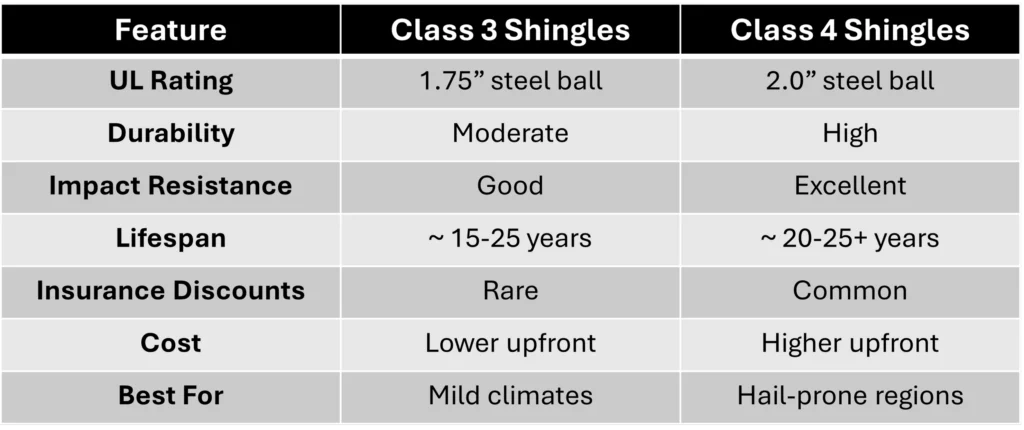
Side-by-Side Comparison Table
To help simplify the differences between these two shingle classes, here is a quick side-by-side comparison that highlights the most important performance factors homeowners should consider.
Who Should Choose Class 3 Shingles?
Class 3 shingles may be a practical option for homes in regions with mild climates and low risk of severe hail or wind. These shingles offer a middle-ground solution for homeowners who want better-than-basic protection without the added cost of a Class 4 product.
Homeowners often choose Class 3 shingles when long-term extreme weather durability is not a primary concern but reliable everyday performance still matters. They provide enough impact resistance for typical seasonal storms but fall short in areas that regularly experience large hail or high winds.
Ideal for:
- Budget-focused roofing projects
- Rental or investment properties
- Warm regions with minimal storm activity
- Homes expected to experience only occasional mild hail events
Who Should Choose Class 4 Shingles?
Class 4 shingles are the best choice for homeowners in hail-prone states or areas where storm frequency is increasing. These shingles are engineered to withstand the types of impacts that often lead to costly roof repairs, helping reduce long-term expenses and providing added peace of mind.
Class 4 products are especially valuable for homeowners planning to stay in their home for many years, as the extended lifespan and reduced maintenance offset the higher upfront cost. Their enhanced durability also makes them a smart choice in regions facing unpredictable weather patterns and rising insurance premiums.
Ideal for:
- Long-term homeowners
- Harsh climates
- Regions with frequent hail
- Those seeking insurance savings
- Homeowners who want maximum long-term roof durability
Is There a Better Option Beyond Class 3 or Class 4 Shingles?
While Class 4 shingles offer the highest level of impact resistance in the asphalt category, there are roofing materials that go even further in durability, longevity, and overall protection. Homeowners in hail-heavy or extreme weather regions often benefit from choosing a material designed to outperform even the toughest asphalt shingles.
Superior Roofing Options Beyond Asphalt
Here are the most notable alternatives:
- Synthetic roofing products (like CEDUR)
- Metal roofing systems
- Premium impact-resistant composite materials
Among these, CEDUR synthetic roofing shakes stand out as one of the best-performing and most versatile roofing materials available today.
Why CEDUR Outperforms Both Class 3 and Class 4 Shingles
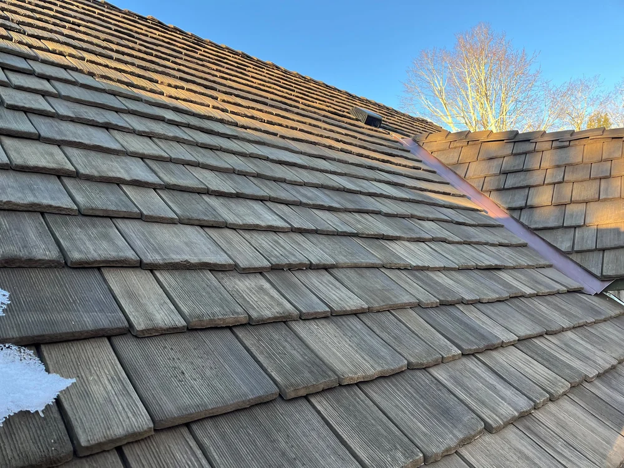
CEDUR is engineered to exceed what both shingle classes can offer, providing the benefits of premium roofing without the weight, fragility, or maintenance requirements found in many traditional materials.
CEDUR shakes deliver:
- Class 4 Impact Rating: Equal to or better than top-rated asphalt shingles, capable of withstanding severe hail without cracking or granule loss.
- Class A Fire Rating: The highest fire-resistance rating achievable, without needing special underlayments.
- Lightweight Design: At only 170 pounds per square, CEDUR eliminates structural concerns that heavy materials like concrete, slate, or stone-coated steel can create.
- Superior Wind Performance: Rated to withstand 115 mph winds, reducing the risk of uplift during storms.
- Zero Water Absorption: Unlike asphalt shingles, CEDUR does not absorb moisture, preventing swelling, mold, mildew, and freeze–thaw damage.
- Real Wood Aesthetics: Each shake is molded from natural cedar, creating authentic grain patterns with deep shading and dimensional texture.
- Fade-Resistant Color: UV-stable pigments maintain rich, consistent color for decades.
- Low Maintenance: CEDUR will not rot, split, crack, curl, or shed granules, and never requires painting or sealing.
- Long-Term Value: With a life expectancy of 50+ years, CEDUR outperforms asphalt shingles in overall durability and cost efficiency.
When CEDUR Is the Superior Choice
Homeowners often choose CEDUR when they want:
- A roofing material that performs better than top-rated asphalt shingles
- Strong protection in hail-prone or wildfire-risk regions
- The look of natural cedar without the upkeep
- Long-term savings from fewer repairs, replacements, and insurance claims
For those seeking maximum performance and peace of mind, CEDUR is the best option beyond Class 3 or Class 4 shingles, combining premium protection with lasting beauty.
Class 3 or Class 4? Which Shingle Class Performs Best?
Class 3 shingles offer moderate protection, but Class 4 shingles deliver the strongest performance, longer lifespan, and more insurance incentives. For homeowners wanting maximum protection in hail-prone or storm-heavy regions, premium alternatives like CEDUR provide even greater durability and climate resilience.
Ready to explore a roofing upgrade that delivers true long-term protection? Contact the CEDUR team today to learn how synthetic cedar shakes can provide superior impact resistance, fire safety, and lasting curb appeal for your home.